Sunday, July 8, 2012

Featured Blog(s): Property of an Anonymous Swiss Collector and Grotesque Stone Idols

Two of my fave blogs lately are Property of an Anonymous Swiss Collector and Grotesque Stone Idols, both written by my friend and future colleague, Dr. Donna Yates. I am not just plugging Donna's blogs because she has been the number 1 diva in the club getting me through the super stressful process of flat hunting in a foreign country from across an ocean. Though that might be 20% of it. The other 80% has to do with how much I've been enjoying and learning from her blogs over the last few weeks. Donna recently got her PhD from Cambridge University in illicit antiquities research-related things, and is now one of the four happy souls leading the ERC-funded study on the trafficking of cultural property at the University of Glasgow. Her work is focused on South American antiquities and archaeology, and over the last few weeks her blogs have been published with exciting regularity on all manner of things from the origins of the word "huaquero" (the Spanish word for looter" to Peruvian-archaeology founder Julio C. Tello to the uh-oh search terms people are using when they stumble across her blog.

Donna's perspective as an academic is really interesting (to me, anyway) because she trained in the archaeology side of things, but leans more toward the heritage/policy camp. The mix of the two results in presenting the historical and present social contexts of these issues in a cocktail of old and new that can't help but reframe your perspective on certain issues. What really makes these blogs fun for me is the fact that Donna uses them to share things she herself has been researching, as opposed to them being a news source with your typical re-hashing of opinion. Additionally, her approach to outreach and education is consciously non-preachy in the hopes of educating those interested in buying artifacts, instead of alienating them through the more aggressive rhetoric that others have adopted. (This attitude is hard to perfect when emotions run so high in this field.) And bonus, it's fun to read. It can often be easy for knowledgable bloggers to fall into a pit of didactic dryness when they're on a roll, but Donna's posts are always a great blend of excited gushing and genuinely interesting information that make them an easy read. Especially in sea of blogs that, though useful and well-written and super interesting, mostly report the major bummers currently going on. No bummers here, man. Just really great blogging.

Saturday, July 7, 2012

This guy has licked every Anglican cathedral in England

I feel a little guilty that I'm not blogging about Timbuktu or looted-coin-collecting bad boy Dr. Arnold Peter Weiss, but am instead clamoring to tell you all about this guy that licked every Anglican cathedral in England on a bet. AND HE'S NOT DONE. In January 2011,  Lawrence Edmonds was challenged by his friend Adam to lick every Anglican cathedral in the United Kingdom. If he doesn't, he'll have to streak outside of York Minster. If he does, Adam will have to streak outside of York Minster. Initially, our cathedral licking hero was given five years to complete this task, which was then pared down to June 16th, 2012. Well. He has licked all 42 Anglican cathedrals in England and was given a six month extension to do the other 20 in the rest of the UK. He was even featured in The Sun and mentioned in the House of Lords. And you can read all about it and see all the licking glory on the official blog, Facebook, and on Twitter.

Edmonds, 26, an English Heritage worker, is careful to mention in his About page that he means no disrespect toward the Anglican Church and its followers, but hopes that his blog will help to promote the cathedrals of the UK, "many of which are currently suffering financially and need thousands of pounds a day just to keep their doors open." I don't think this is what any of us would have considered as a viable option in promoting some of the more expensive and endangered architecture of the UK, but I have to slow clap this guy and his friend for stumbling across it. Here's hoping that the spirit/form of it might catch on with other individuals and forms of architecture.

Now hoping I'll run into this cathedral-licking renegade around some of Glasgow's Anglican structures this fall.

Monday, July 2, 2012

What a good study looks like

We all knew from the start that the University of Glasgow study on the global trafficking of cultural property was going to be a big deal. But these folks are really outdoing themselves by keeping the public updated (to a certain extent) through their new social media. You can now follow the study, which is being led by Neil Brodie, Simon Mackenzie, Donna Yates, and Suzie Thomas, through their Facebook and Twitter pages. It seems a website will be following soon! It would be so interesting if more studies approached social media as a tool for educating the wider public and keeping people up to date in a sort of live-feed way on the process of their research.

Beyond excited to get to work with these people this year.

Friday, June 29, 2012

Big news!

Since my last post in March, life has been a whirlwind of thesis-writing, thesis-editing, unplanned grad school applications, social media neglect, undergraduate graduation, grad school rejection/acceptance, conference prep, and crazy weekend travel to Europe. Not coming back to blogging sooner partly has to do with temporarily forgetting how to write for non-thesis/presentation purposes, but mostly to do with the crazy number of events, landmarks, and decisions that have been packed into the last three months.

Per esempio, I am fairly ecstatic to tell people that this fall I will be pursuing my Master of Research in Criminology at the University of Glasgow. At the encouragement of Donna Yates, I applied for a PhD scholarship being offered in conjunction with the now famous University of Glasgow trafficking culture study. My humble expectation of being rejected wasn't entirely off; I didn't get the scholarship, but, to my honor and surprise, the selection committee thought my proposal was pretty cool and told me so. Simon Mackenzie sent me the best rejection letter of my life and invited me to do an MRes in Criminology with them before pursuing a PhD. 48 hours of feverish calculations later, I said yes. And not just because the opportunity was being handed to me/smacking me in the face and I realized that I could afford it.

If this opportunity had not arisen, I would most likely have spent the next year working a crap job, saving money, and applying to cultural heritage grad programs with the uneasy suspicion that someday, I would have to choose sides between archaeologists and museums. Because my work has increasingly focused on how to bring the two sides of academia together, choosing between the two is the last thing I want to do. Going the criminology route had not occurred to me until Simon suggested it, and in retrospect it seems kind of dumb. After letting the duh-ness of it sink it, this feels like the most natural and obvious direction for my research interests. Through criminology, I can approach the multi-party conflict over the illegal trafficking and display of looted artifacts from a much more neutral position and with a great deal more information about how to approach a multi-party conflict in the first place. Not only that, but the people I'll be working with at Glasgow are already super welcoming and supportive. Coming from a really small school where it's not uncommon to cry in front of/with your advisor and students and faculty are all on a first-name basis, it was important to me to find a program that would offer the same kind of one-on-one support and possibility for really meaningful scholarship and collaboration. Glasgow seems to have a close-knit, small-town-vibe despite being a big city uni, and I could not be mored excited about joining them this September!

But what does that mean for this blog? I have always intended Things You Can't Take Back to be primarily for college students finding their way into these issues, and me being a grad student won't change that goal. However, it will change how I approach that goal. Now that I'm graduated and have the benefit of hindsight as well as more sophisticated resources and connections, I hope to do a much better job of actually reaching college students and communicating the issues in a way that impassions them and encourages them to find a career in this field. Some changes and additions to the resources on this blog will be taking place over the next couple months, hopefully to find some equilibrium by the time I start going crazy again with school.

Keep an eye out this week for my perspective on the amazing time I had at the ARCA conference this past weekend!

Wednesday, March 14, 2012

Chasing Aphrodite authors propose WikiLoot, a crowd-sourced initiative to address the illicit antiquities trade

Polaroid seized from Giacomo Medici's warehouse
Jason Felch and Ralph Frammolino, authors of Chasing Aphrodite, are two of the most tireless voices in the fight against the illicit antiquities trade right now. In addition to their fantastic book and their presence on Twitter and Facebook, they have just proposed WikiLoot, an entirely new initiative that, if successful, could revolutionize how we approach the illicit antiquities trade. The idea behind WikiLoot is that it would be an open source web platform for "the publication and analysis of a unique archive of primary source records and photographs documenting the illicit trade in looted antiquities." The wiki would use social media "and other tools" to bring together YOU plus a big network of experts (journalists, researchers, dilettantes, etc.) to collaborate on the analysis of a collection of photos of unpublished and missing artifacts that do not come from a known collection. Right now, Jason and Ralph are applying for funding, specially from the Knight Foundation, from which they've requested $250,000 to contribute to their $350,000 goal.

My own first impression of this is HOLY CRAP THIS IS WHAT WE'VE NEEDED ALL ALONG. One of the biggest problem with addressing the illicit antiquities trade has been the question of how to involve the general population. For such a global issue, the problem-solving has so far been limited to a relatively small network of police, academics, and lawmakers. Opening the problem-solving up to EVERYONE could be the kick in the pants that this fight really needs. However, there are admittedly a lot of issues that accompany this kind of proposal, so Jason and Ralph have created a Facebook group for people to discuss their questions, work out kinks, and come up with some creative ideas to make WikiLoot more than just a concept. The conversation itself is already super interesting; I don't know anywhere else on the internet right now where you can watch the experts/major reporters in this field (so far featuring Jason Felch, Larry Rothfield, David Gill, James Grimaldi) discuss together the pros and cons of an initiative like this. Read more about Jason's proposal on the Chasing Aphrodite blog, definitely "like" or comment on the proposal on the Knight Foundation Tumblr to help WikiLoot to get funded, AND join in the conversation on the WikiLoot open Facebook group!

Thursday, March 1, 2012

Dig Ventures' outside-the-box method to archaeology could revolutionize the economics of excavation

Dig Ventures, a British organization that provides "seed capital for archaeology projects worldwide", just launched a whole new kind of funding initiative that promises to change the way we think about funding archaeology and I can succinctly describe as "kick ass". In order to excavate Flag Fen in Cambridgeshire, England, a Bronze Age site that is being threatened by extensive drainage and climate change, Dig Ventures is using Sponsume, the European equivalent of Kickstarter, to reach out to the public for funding. The thing is, they're providing everyone with the incentive to back the project with the opportunity to be involved in the actual dig. £10 gets you "exclusive backstage access to daily content on our website in the 'Site Hut', a PDF of the final report, plus an invitation to our end of site party!" while contributing up to £1,300 or more gets you master classes and evening lectures.

The BBC just published an article today about the venture, in which Lisa Westcott Wilkins, the managing director of Dig Ventures, was quoted:
"Most of the archaeology outside of universities happens in advance of infrastructure or building, so when the market for that slows down, we don't get to dig very much," explained Mrs. Wilkins. "We've been thinking for a long time that things need to change, that there's not the kind of outreach that we feel really could be happening. There are lots of good people who are held back by the traditional way of doing things."
This crowd-sourced, crowd-funded approach to excavating important sites and engaging/educating the public in the process is, frankly, so brilliant that I think we all just want to shout, "DUH." This is an amazingly hands-on approach to a problem that all of us here in the States have been bitching about ever since we discovered that Spike TV and the National Geographic sold their souls for shows like "American Diggers" and "Diggers". Television programs like this are obviously very frustrating for archaeologists and individuals who love responsible archaeology. However, I think that on a quieter level, they have also sparked the realization that the archaeological community has not made the kind of aggressive motions they need to make in fixing a widespread misunderstanding of the ethical differences between responsible archaeology and treasure hunting. Pop culture and reality TV shows with "digger" in the title are just inflating this misunderstanding, and encouraging people to volunteer at professional digs is not proving to be enough incentive for the general public to support responsible archaeology. I see Dig Ventures project as a very clever way of addressing two big issues: first, it's a brilliant way of engaging and education people in archaeology. Second, it's a very creative way of getting funding in an economic environment that generally has little to no funding for archaeology. But I think there is a third, hidden advantage to this kind of initiative: it is a brilliant way of communicating the economic value of keeping heritage intact.

When people outside the archaeological community can see the cost of what it takes to excavate and preserve historical sites (versus what they might spend on a single artifact that was commercially exploited and illegally obtained), it might very effectively drive home the fact that it is cheaper, safer, and more productive to support archaeology and preservation than it is to engage in the illicit art market. The numbers of archaeology are not nearly so scary as the numbers behind the illegal sale of cultural property. £25,000 ($39,837.50) to excavate an entire Bronze Age site versus the $1 million paid by the Met for the Euphronius Krater? Not to mention all the jobs, training, and educational opportunities provided by a mere £25,000 excavation versus the asymmetrical distribution of money and incomplete information provided by a cool $1 mil for a single object without a reliable provenance? Bitch, please. These are the kinds of numbers that could mobilize people on the ground, not just in academia.

Good luck to Dig Ventures in achieving all they've set out to accomplish!

Monday, February 27, 2012

It's Museums Advocacy Day!

Today and tomorrow are Museums Advocacy Day, an event sponsored by the American Association of Museums and designed to advocate for policy and funding issues that affect museums in the United States. Today and tomorrow there will be events on Capitol Hill that you can watch here. However, if, like me, you're not able to make it out to D.C. to make an impact in person, there are other things you can do.

AAM's E-Advocacy page is mostly for museums, but no one's going to stop you from also writing to your representatives and making a fuss about it via Twitter (#museumsadvocacy) or Facebook or whatever. The point is, do something. If you're reading this blog, you probably already know (either consciously or at least deep down) that museums are the safe guards and celebrations of our shared heritage, both material and intangible. As Americans, we have a particular responsibility to make the protection and preservation of our museums a priority because of the vast number of cultural memories and identities they serve. So jot off a quick letter to your state representatives! For reference, here's what I wrote to Senator John Kerry (with some help from the letter guides provided by AAM):


Dear Senator Kerry,

As a constituent, I know that you are pulled in many, many directions and must make difficult decisions every day about how to meet the needs of people like me and our community. I recently learned, through the American Association of Museums, how important it is that I take a moment to express to you why museums are so special to me.

There was recently an article in the BBC about how lack of funding in Bosnia has affected museums. During wartimes, the museum workers dodged bullets and bombs to protect the material manifestations of their cultural heritage and shared history. Now during hard economic times, Bosnian museum workers have not been paid for six months and are taking on part-time jobs to support themselves while they continue to work for their country’s museums. During World War II, museum workers at the Hermitage in Russia barricaded themselves in the museum’s basement tunnels and died of starvation and cold protecting their collections from the violence of war. And just a few years ago in 2003, Donny George risked his life during the American invasion of Iraq in an attempt to protect the Iraq National Museum from looters.

Museums are the safe guards and celebrations of our shared heritage, both material and intangible. When our way of life is threatened, we look to museums to remind us who we are and to keep our identities alive. As Americans, our museums contain a vast number of cultural stories and memories, giving us a great responsibility to make the protection and preservation of our many cultural identities a priority. We need to support our museums now so that we may not have to sacrifice so much for the protection of our histories in the future.

Essentially, I grew up in museums. As an adult, I continue to grow up in museums as I graduate from college this year and dedicate my life to museums; to figuring out how they work, how to make them work better, and how to continue to protect the world’s history in ethical and educational ways.

As a representative of our great state of Massachusetts, I hope you will remember how important museums are to me and provide support for museums in your future work.

Sincerely,

Meg Lambert

Sunday, February 26, 2012

Spike TV's new show, American Diggers, promotes commercial exploitation of historical sites

This spring, Spike TV intends to air a new show called American Diggers, which will follow a team "led by former professional wrestler-turned-modern-day relic hunter Ric Savage as they scour...battlefields and historic sites, in hopes of striking it rich by unearthing and selling rare pieces of American history."

Let me break it down for you: THIS IS BAD because shows like this perpetuate the idea already put forth by pop culture icons like Indiana Jones that cultural property is "treasure": old things with great economic value. This is not responsible archaeology, and it needs to be shut down. Sign this petition on Change.org to urge Spike TV to cancel the show before they can continue to poison the minds of America with the idea that looting is fun and stuff.

Thursday, February 23, 2012

Ancient Olympia Museum robbed and Geroulanos a coward for resigning?

Gold ring seal, Antheia, Messinia. Date: 14th or 13th century. 
It's been all over the news: last week two armed robbers broke into the Archaeological Museum of Olympia, tied up on the only on-site guard, smashed and made off with 77 artifacts dating back more than 3,000 years. It was the second devastating blow to Greece's cultural heritage in the midst of their economic crisis after paintings from the National Museum were stolen last month. Due to extreme budget cuts, funds for security have been halved in the last few years, leaving Greece's cultural institutions incredibly vulnerable to theft and looting. So, far the case at Olympia remains at a dead end, made even more complicated by the fact that it appears the police and the Ministry of Culture and Tourism are releasing differing information about their understanding of the heist. 

However, the most concerning aspect of this case for me is that due to the embarrassment of the break-in, culture minister Pavlos Geroulanos submitted his resignation to prime minister Lucas Papademos. Papademos rejected it yesterday, which could be both a good and bad thing. The entire situation is giving me flashbacks to around this time last year when Zahi Hawass resigned as from the antiquities department in Egypt after the many cases of break-ins and looting through the revolution and limited resources to deal with it. At the time, Hawass blamed the lack of resources and security for his inability to prevent chaos. He said, "I cannot stay in Egypt and see antiquities being stolen when I cannot do anything to stop it! This situation is not for me!" The problem is that there very probably were things he could have done to better prevent mass looting of archaeological sites and the looting at the national museum, including reaching out to international organizations and mobilizing the kinds of youth who locked arms in front of the museum. With Greece currently in a similar situation, it might have been wise for Geroulanos to learn from Egypt's tragedies and mistakes and do what he could to deal more creative and proactively. For some perspective, this situation compared with how Bosnia is dealing with their current funding issues is particularly embarrassing: while museum workers in Bosnia have historically dodged bullets to save their artifacts, have not been paid for six months, and are taking on part-time jobs to support themselves while supporting their museums, Greece's culture minister has thrown up his hands after two high-profile (and therefore easier to track down) museum thefts.

I personally see these resignations as cowardly and ineffective. (Though, in the case of Hawass, it was time to get rid of him anyway.) Maybe I'm just young and naive, but to me Geroulanos's resignation was essentially an admission that he was unwilling to support his country throughout this difficult time in any way his government position may allow. Geroulanos is still minister for now, but I hope that a much stronger replacement can be found as soon as it is financially or politically possible.

Wednesday, February 15, 2012

Glasgow University Team gets £1m grant to study illicit antiquities trade

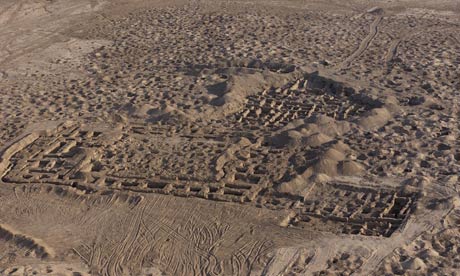
A looted archaeological site in Iraq from the air in 2003. Copyright: Italian Carabinieri
In case you somehow haven't heard or just aren't paying attention, researchers at Glasgow University were recently awarded a £1 million grant from the European Research Council to study the illicit trade in antiquities. For those of you who are new to studying these issues, this is what is what the more arcane academics like to call "a big freaking deal." Over the next four years, a team led by archaeologist Dr. Neil Brodie and criminologist Dr. Simon Mackenzie will gather and analyze data on the movements and motives of traffickers, the activities involved (such as illegal excavation/looting), and pricing structures. The goal of this grant, as described by the Guardian, is to "develop new approaches to regulate the international trade of cultural goods and help policymakers better define laws to fight criminal activities."

This is incredible for a number of reasons. First, to my knowledge there has never been such a generous amount of funding directed towards the study of the illicit antiquities trade until now. So much of what we know about illegal artifact trafficking is cobbled together from various international busts and trials, some hard-won insider information, investigative journalism on very particular controversies, and years of accumulated blog posts chronicling the changing nature of collecting. It is often incredibly difficult to get solid statistics from those kinds of patchwork sources. This study will be the first of its kind on the illicit antiquities trade, and will undoubtedly be groundbreaking in deepening our understanding of how illegal artifact trafficking operates. Second, Dr. Brodie and Dr. Mackenzie are already well-known in this field for their groundbreaking research on the illicit antiquities trade. Considering what they have already achieved on what one can assume is a fairly average budget, it is astonishing to think what they will accomplish with such a large sum over a relatively short amount of time. Third, can you imagine the kind of research opportunities this one study will inevitably open up to our generation of academics? This is the perfect time for ambitious grad students and bold undergrads to make a good case for focusing on the illegal antiquities trade and demand funding for its study. The findings from this research will undoubtedly give us twice as many questions as they will answers, and here's hoping those questions will require more studies that young, lively bloggers like me may soon be a part of.

For more information, here's a rather brilliant piece on Prof. Mackenzie contrasting his work with Indiana Jones' tomb robbing. (When will that stereotype die, already?)

Congratulations to Dr. Brodie, Dr. Mackenzie and their team at Glasgow University!